 Sandbox
 LAND connects publishing requirements to verifiable parcel ownership
One Sandbox LAND is a unique ERC-721 parcel tied to a Map location where an eligible Experience can be launched. Before buying, identify the network, confirm the LAND contract, match the token ID and coordinates, and check that the intended wallet can satisfy the publishing requirements. A listing or wallet image is insufficient because it can be stale, incomplete, or tied to the wrong collection. The decisive ownership record is the owner field for the correct contract and token ID on the correct chain. The connected account and expected Map location provide separate platform-recognition checks.
LAND functions that matter before a purchase
A LAND parcel has two related functions. It is a unique ERC-721 token with an owner recorded on a supported blockchain. It also supplies the Map location where an eligible Experience can be launched. The token record proves custody of the parcel, while the publishing tools determine whether an Experience is ready to use that location.
Creators can build an Experience and create an Experience Page without owning LAND. Publishing playable content to the Map has stricter conditions. The Experience must be in the relevant inventory, the required assets must be controlled by the publishing account, and a suitable LAND location must be available. Parcel ownership alone does not complete the asset review, page setup, or launch preparation.
LAND can also be transferred, sold, bridged between supported networks, combined with adjacent parcels into an Estate for a larger Experience. These actions can affect ownership, network, parcel grouping, or Map-placement records. A completed purchase changes the blockchain owner, whereas selecting a location connects an Experience to compatible space on the Map.
Publishing requirements set the purchase boundary
One parcel is sufficient only when the Experience fits a 1x1 location. A larger build needs a LAND location with matching dimensions. For separately owned adjacent parcels, check whether the publishing interface recognizes the group or requires an Estate. Checking this fit before purchase prevents ownership of valid parcels that cannot hold the intended layout.
Experience and asset control
The Experience, LAND, and assets used for Map publishing must be in the same wallet connected to the publishing account. Asset Review separates items that are ready from NFTs that must be acquired and assets that are unavailable. An unavailable asset needs replacement in Game Maker. Purchasing LAND does not resolve a missing or unusable asset.
Location fit
The location must match both the size and orientation of the Experience. Adjacency means that parcels touch along a side, not only at a corner. Before relying on separate parcels, confirm whether the publishing interface recognizes them as a valid combination or requires them to be merged into an Estate.
One parcel
A 1x1 Experience can use a single compatible LAND. The parcel still needs to appear in the wallet and account that will perform the publishing work.
Adjacent parcels
A 3x1 Experience needs a LAND location with the same 3x1 shape. A 1x3 arrangement does not satisfy that shape because Experiences cannot be rotated during location selection. Before treating separately acquired parcels as usable publishing space, confirm whether the publishing interface accepts them together or requires an Estate.
Network and contract identity define the asset
LAND records exist on Ethereum and Polygon, with a separate token contract on each network. Official LAND sales moved to Polygon in November 2022, while parcels can also exist on Ethereum. A wallet interface that displays the collection name without the chain and contract leaves out information needed to authenticate the token.
The Ethereum LAND contract used from January 2022 is 0x5CC5B05a8A13E3fBDB0BB9FcCd98D38e50F90c38.
The Polygon LAND contract is 0x9d305a42A3975Ee4c1C57555BeD5919889DCE63F.
Contract address characters and order must match, although hexadecimal letter case does not change the address. A similarly named collection at another address is a different asset.
Network identity matters again when the parcel is received. A Polygon purchase should produce a Polygon ownership record, and an Ethereum transfer should remain visible on Ethereum unless a bridge operation follows. The same numeric token ID on two unrelated contracts does not identify the same token.
What proves ownership of a LAND parcel?
The owner recorded for the correct contract and token ID proves on-chain ownership. The displayed owner address must match the intended receiving wallet after the transfer is confirmed. A sale page, transaction request, or marketplace profile cannot replace that comparison because each describes an offer or action rather than the final token state.
The connected account then supplies a separate operational check. The parcel should appear in its LAND inventory and resolve to the expected Map position. This second check shows that the platform recognizes the wallet record needed for management and publishing. It does not override the blockchain owner field.
Confirmation also depends on the transaction type. An approval can authorize an operator to move a token, while a transfer changes its owner. A signature used to authenticate a wallet may change neither state. Read the completed transaction effect instead of treating every wallet confirmation as proof of purchase.
Map location, token ID, and wallet record must agree
The parcel can be followed across several views without relying on its display name. Start with immutable or address-bound identifiers, then use the Map as a location check. Names, thumbnails, descriptions, and sale terms can change without changing the underlying LAND token.
- Match the blockchain and LAND contract before evaluating the listing.
- Match the token ID shown for the parcel and completed transfer.
- Compare the recorded owner address with the destination wallet address.
- Confirm that the account inventory opens the expected Map coordinates.
- Review the Experience dimensions against the parcel or combination shape.
A mismatch has to be explained before another transaction is signed. The wrong contract can indicate a lookalike collection, while the wrong token ID can point to another parcel in the genuine collection. A correct owner with an unexpected Map location usually calls for another token ID and coordinate comparison.
A worked ownership check before commitment
In this hypothetical example, every changing input is symbolic: candidate listing L, token ID T, seller address S, destination wallet W, coordinate C, and Experience E. The selected route is a Polygon purchase, so L must identify T under the Polygon LAND contract. Before signing, the reader compares S with the recorded owner and checks that T resolves to C. Experience E must fit the parcel shape and remain available through the account intended for publishing.
Time matters because the owner, approval, and listing state can change. The reader repeats the contract, token ID, and owner check immediately before commitment without assuming that an earlier screenshot remains valid. The purchase must transfer T to W rather than merely authenticate the wallet or approve an operator.
Completion occurs only after the confirmed token record names W as owner. The account connected to W should then show T, and its LAND entry should open coordinate C. If the chain names W but the inventory has not updated, the purchase is not repeated. Ownership is already complete on-chain, while platform recognition remains the unresolved state.
Can rented LAND satisfy the publishing requirement?
A private rental arrangement can supply publishing space only when the LAND, Experience, and required assets meet the same wallet and account conditions used for a normal launch. The documented platform flow does not provide a built-in LAND rental system. Private arrangements therefore depend on how the parties place the relevant items together and who controls the hosting account.
That custody choice changes the risk. Moving an NFT requires a wallet-approved transaction, but an Experience or an asset that has not been minted as an NFT may be transferred through account controls. Anyone considering a private arrangement needs to distinguish parcel ownership, Experience control, asset ownership, and access to the account. A rental message or payment record does not create on-chain LAND ownership.
Hiring a builder creates a related handoff issue. The completed Experience must be available to the account that will launch it, even though the creator can retain copyright in the game. Confirm that handoff separately from the LAND transaction because they use different records and permissions.
Bridging changes the network, not the parcel
The Sandbox Bridge moves supported LAND between Ethereum and Polygon. It does not create an additional parcel or transfer ownership to a buyer. During the move, the source transaction and destination record belong to one bridge operation, so ownership should be checked on the destination chain only after that operation completes.
A bridge request is different from a marketplace purchase. It starts with a parcel already controlled by the same user and changes the network where that token can be used. Contract selection must follow the destination network. Checking only the Ethereum record after a completed move to Polygon can make a valid parcel appear absent.
When the records disagree
The blockchain owner, connected inventory, and Map view can disagree for different reasons. Repeating a purchase does not diagnose any of them. First identify which record changed and which expected record did not.
The chain names the destination wallet
If the correct token contract records the destination wallet as owner, the transfer succeeded on-chain. Confirm that the same wallet is connected to the intended account and that the correct network is selected. A missing inventory entry or delayed Map display is then a recognition issue, not evidence that another purchase is required.
A parcel can also be genuine while remaining unsuitable for the planned Experience. Recheck its coordinate, dimensions, and adjacency after the ownership record is settled. Valid ownership does not turn a separated group of parcels into a usable combination.
The chain does not name the destination wallet
Inspect the completed transaction before relying on its successful status. It may record an approval, a failed token transfer within a broader interaction, or a transfer to another address. Compare the recipient, contract, token ID, and event rather than inferring the effect from a wallet notification.
If the correct LAND appears but Asset Review still blocks launch, return to the listed asset state. An NFT may need to be acquired, while an unavailable asset must be replaced in the Experience. The parcel transaction should remain untouched because it solved a different requirement.
Completion means the records agree
Acquisition is complete when the intended wallet owns the correct token ID under the LAND contract on the selected network. Platform recognition is complete when the connected account displays that parcel and its expected Map location. Publishing readiness adds the Experience, asset, page, and spatial requirements.
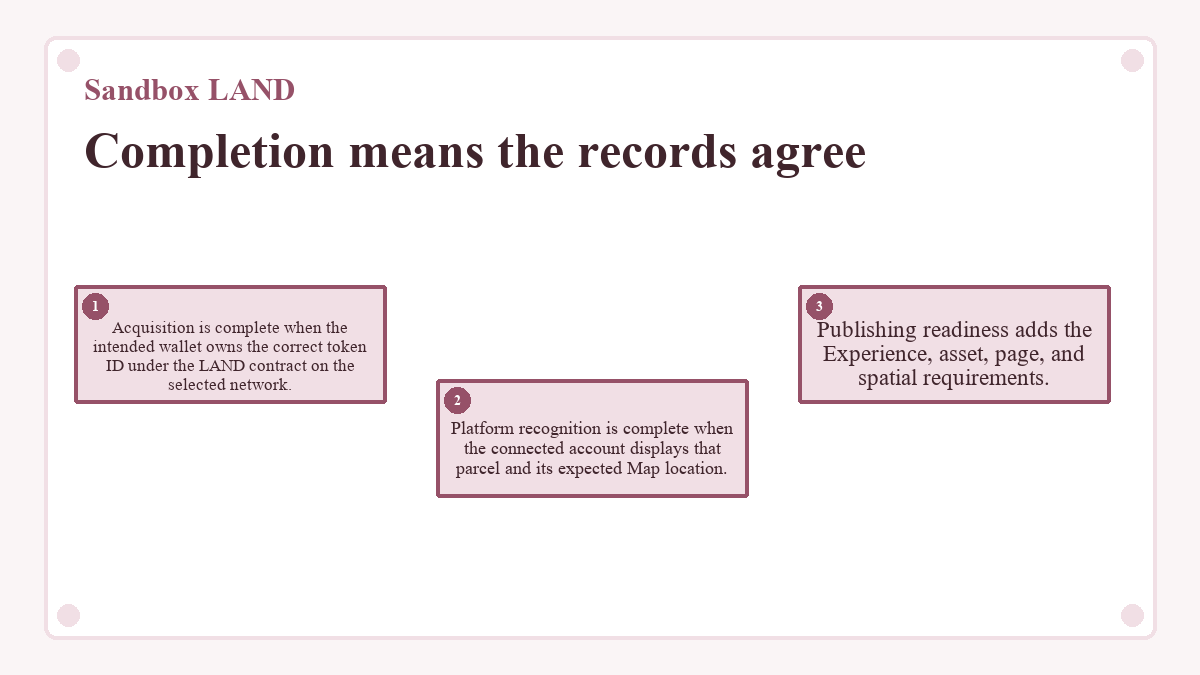
Keep those states separate when deciding whether to proceed, wait, correct an account connection, or stop. A visible listing only describes an offer at that moment, while a confirmed owner record establishes custody. Publishing readiness means that the chosen Experience can use the verified LAND location.
The fixed supply does not change these checks. The Sandbox defines a total of 166,464 LAND parcels, and each authentic parcel still needs its own contract, token ID, owner, and Map position.
Sandbox LAND FAQ
Can an operator approval prove that a buyer owns the LAND?
No. An ERC-721 approval allows a specified operator to transfer a token under the approval’s conditions, but it does not change the recorded owner. Ownership changes only through a completed transfer. Compare the owner field before and after the transaction, and confirm that the event concerns the expected LAND contract and token ID.
Are additional NFTs guaranteed with a secondary Premium LAND sale?
No. A secondary seller can offer the Premium LAND alone or bundle other NFTs under the sale terms. Premium status does not prove that every asset from an earlier sale remains included. Inspect the exact tokens covered by the transaction. The LAND token, its location, and any accompanying NFTs are separate items that require separate confirmation.
How long does a LAND transfer take to appear in every view?
There is no single duration that proves completion across the blockchain, account inventory, and Map. First wait for the transaction’s actual confirmation, then check the owner under the correct contract. If the owner has changed but the platform view has not, treat the remaining issue as account recognition or indexing. Do not submit a duplicate purchase merely because one view lags.
Are adjacent LAND parcels automatically converted into an Estate?
No. Owning neighboring parcels does not automatically merge them into an Estate. An Estate is a larger parcel formed by merging adjacent 1x1 LAND NFTs.
Can a 3x1 Experience use three separately acquired LAND parcels?
Yes, if the parcels touch along their sides, form the required 3x1 shape, and are held in the required wallet arrangement. A 1x3 group does not qualify because the Experience cannot be rotated during placement. Confirm whether the publishing interface accepts the separate parcels together or requires them to be combined into an Estate.
Is LAND ownership the same as copyright in an Experience?
No. LAND ownership concerns the ERC-721 parcel, while the designers retain copyright in the Experience they create, subject to third-party rights and the platform’s terms. A parcel owner does not acquire a creator’s game merely by owning its location. Private collaboration still needs clear control of the Experience, assets, account, and LAND used for publishing.